

April 7, 2026 – Cloocus is strengthening its position as a key partner accelerating the adoption of artificial intelligence (AI) in the public sector. By providing hands-on training, concrete AI adoption roadmaps, and end-to-end support strategies, the company aims to expand the practical use of AI across public and research institutions.
On April 2, Cloocus hosted a Google Cloud Hands-on Seminar in collaboration with Google Cloud at the Daejeon Daedeok Tech-Biz Center. The event drew strong participation from research organizations located in the Daedeok Innopolis research complex.
Rather than focusing solely on AI feature introductions, the seminar emphasized practical, hands-on programs that participants could immediately apply to their research workflows. Google Cloud presented real-world use cases for generative AI, highlighting how it can be utilized in research environments. Key topics included digitization of document- and image-based data, workflow automation using optical character recognition (OCR) combined with AI, and significant productivity gains through reduced repetitive tasks.
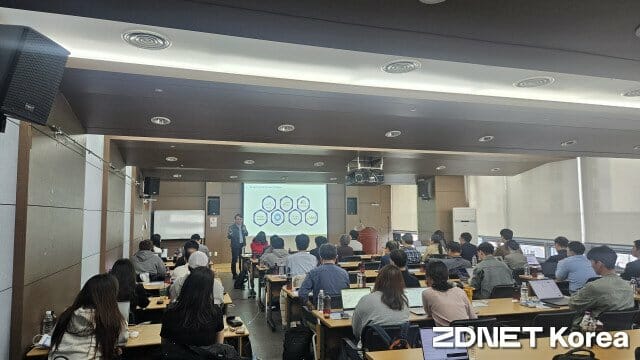 Cloocus hosts a hands-on seminar for research institutions in Daejeon together with Google Cloud. (Photo: ZDNet Korea)
Participants were also advised that adopting AI through software-as-a-service (SaaS) or platform-as-a-service (PaaS) models is a more practical alternative than building AI systems from scratch. As AI technologies evolve rapidly, self-built systems often impose heavy maintenance and operational burdens and struggle to keep pace with innovation.
As a core Google Cloud partner, Cloocus led in-depth training sessions focused on the use of generative AI tools. Attendees engaged in hands-on exercises using Gemini, Google AI Studio, and NotebookLM, learning how to apply these services to real research tasks such as data analysis, document drafting, and knowledge organization.
Cloocus also shared real-world application cases, including research hypothesis generation through Gemini-based multi-agent systems, diagnostic support using AI models specialized for healthcare, and service implementations built on AI agent architectures. According to Cloocus, these initiatives have delivered four key outcomes: reduced work time, improved accessibility, evolving researcher roles, and the generation of new insights.
The seminar further highlighted the shift in AI usage from chatbot-centered applications to agent-centered systems. Instead of responding to isolated queries, AI agents are increasingly capable of planning tasks autonomously, selecting appropriate tools, and executing workflows toward defined goals. Looking ahead, Cloocus expects this evolution to expand into multi-agent collaborative environments.
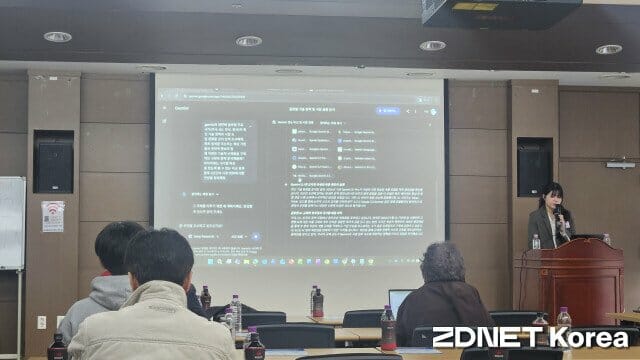 Jisu Oh, Consultant at Cloocus, delivers AI hands-on training for seminar participants. (Photo: ZDNet Korea)
“Work environments are evolving beyond simple information searches toward AI-driven systems that summarize results and deliver actionable insights,” said Jisu Oh, Consultant at Cloocus. “Research institutions can significantly enhance productivity across the entire research lifecycle—from paper analysis and code generation to data interpretation—by leveraging AI.”
She added, “With technologies such as Google’s AI co-scientist, research hypothesis validation processes that once took years can now be completed in a fraction of the time. AI is not meant to replace researchers, but to serve as a collaborative tool that maximizes research efficiency.”
The seminar adopted a hands-on format encompassing the entire research workflow with generative AI. Participants practiced deep research using Gemini, designed result verification loops, utilized NotebookLM for paper summarization and document organization, and generated presentation materials. Notably, Gemini’s data analysis capabilities drew strong interest, as they demonstrated clear potential for reducing repetitive data preparation tasks.
Cloocus also outlined its public sector enablement strategy during the session. The company has registered Google Cloud–based AI services with the Ministry of Science and ICT’s Digital Service Procurement System, allowing public and research institutions to purchase AI solutions via the Public Procurement Service without separate contracting procedures. This initiative significantly accelerates AI adoption in the public sector.
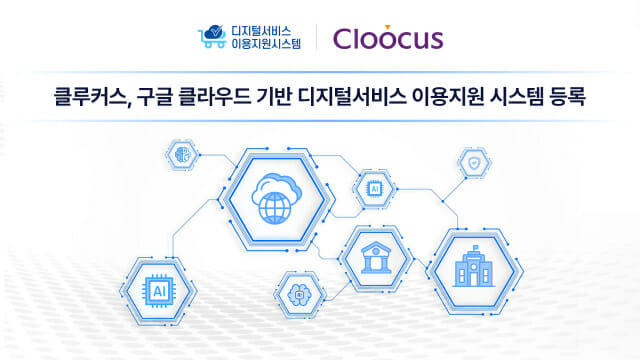 Cloocus registered Google Cloud–based AI services with the Digital Service Procurement System last year. (Photo: Cloocus)
“Public and research institutions place a strong emphasis on security and data governance, making trust and integration critical in enterprise AI environments,” said Jisu Oh, Consultant. “Google Cloud–based AI solutions meet these requirements while enabling rapid deployment into real-world workflows.”
She emphasized a phased deployment strategy, adding, “Starting with AI adoption in simple, repetitive tasks is the most realistic approach. Building small success stories and scaling them organization-wide is key to sustainable transformation.”
Looking ahead, Cloocus plans to expand AI adoption support across public and research institutions. The company aims to provide comprehensive assistance throughout the entire lifecycle—from technology consulting and implementation to ongoing operations—thereby accelerating AI adoption in the public sector.
“This seminar was designed as a hands-on program that allows research institutions to apply generative AI directly to their daily work, rather than viewing it as a conceptual technology. We will continue supporting the on-site expansion of AI utilization across diverse industries and research fields,” said Steve Hong, CEO of Cloocus.

Cloocus Corp.
[United States] 500 7th Ave. Fl 8 New York, NY 10018 | Tel.+1 408.7722024 | E-mail.info_us@cloocus.com
[Malaysia] A-3A, Block A, Level 3A, Sunway PJ51A, Jalan SS9A/19, Seri Setia, 47300 Petaling Jaya. | Tel.+6016 331 5396 | E-mail.infoMY@cloocus.com
[Korea Headquarter] 6, Nonhyeon-ro 75-gil, Gangnam-gu, Seoul, Republic of Korea 06247 | Tel.02-597-3400 | E-mail.marketing@cloocus.com
[Korea Busan Campus] 55, Centum jungang-ro, Haeundae-gu, Busan, Republic of Korea | Tel.051-900-3400
[Japan] ARK Hills Front Tower, 2-23-1 Akasaka, Minato-ku, Tokyo | Tel.+81 3.5575.7808 | E-mail.infoJP@cloocus.com
Copyrights 2024 Cloocus co.,ltd. all rights reserved.